Jerusalem - Palestinian officials and representatives of Jerusalem-based institutions have highlighted the significant role played by the Bayt Mal Al-Quds Asharif Agency (BMAQ), the executive arm of the Al-Quds Committee chaired by HM King Mohammed VI, in supporting key sectors across the city. They described the Agency’s programmes as instrumental in strengthening resilience and advancing sustainable development.
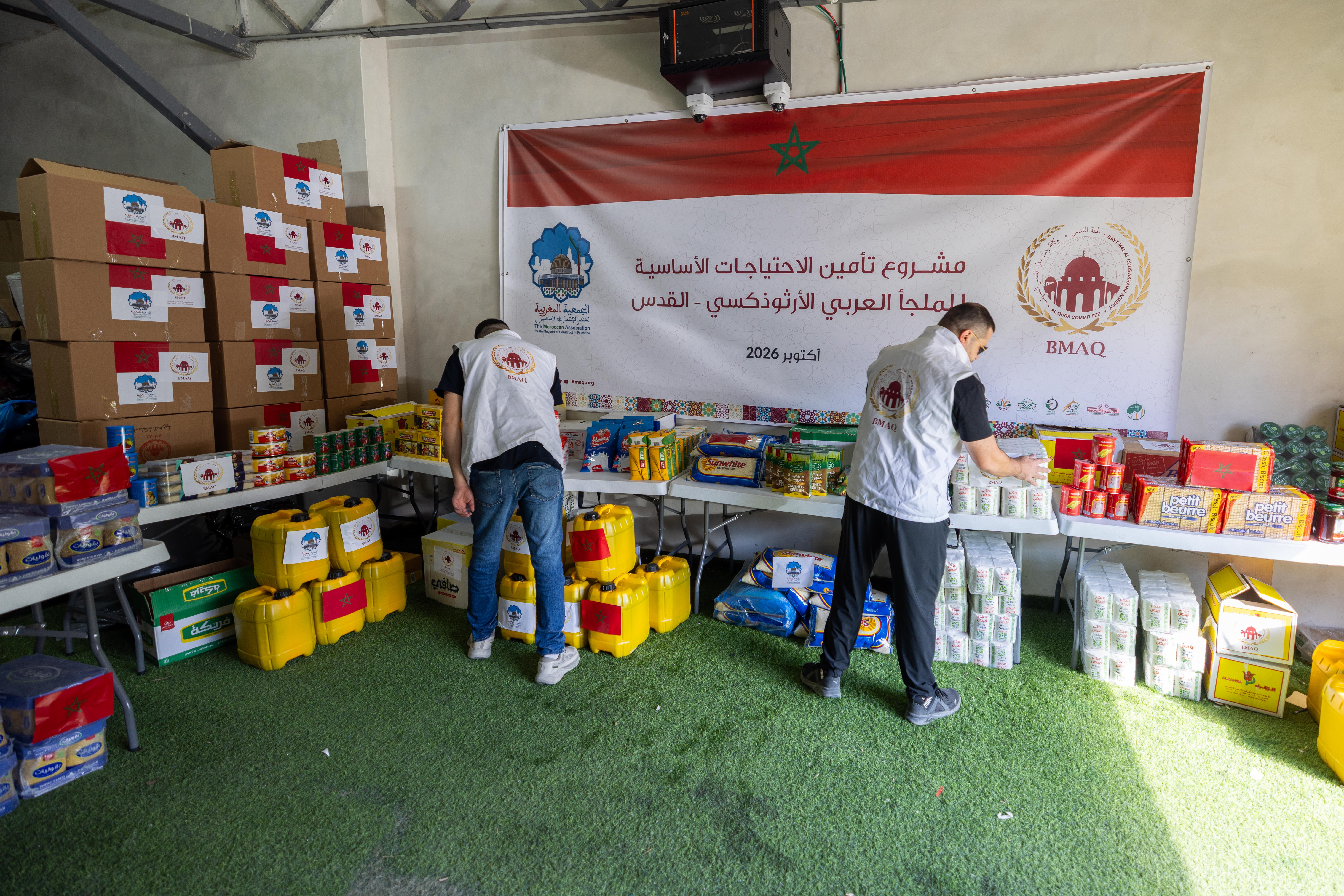
They noted that, throughout 2026, the Agency’s programmes spanned healthcare, education, economic empowerment, agriculture, restoration and scientific research, helping address the needs of wide segments of the population, support local institutions and strengthen their capacity to sustain service delivery.
They emphasized that the programmes’ impact extended beyond direct assistance to encompass capacity-building, support for productive activities, preservation of Jerusalem’s architectural heritage and documentation of its historical memory, thereby reinforcing the foundations for resilience and sustainable development in the city.
They expressed their heartfelt gratitude to HM King Mohammed VI, Chairman of the Al-Quds Committee, for His Majesty’s steadfast support for the Palestinian people and continued patronage of BMAQ, whose humanitarian, social and development programmes provide vital support to Palestinians.
They highlighted that Palestinians directly benefit from the Agency’s services, underscoring that Morocco’s support goes beyond political and diplomatic advocacy to encompass educational, humanitarian and development initiatives that address Jerusalemites’ needs and help secure their future.
In this regard, Sheikh Mohammed Hussein, Grand Mufti of Jerusalem and the Palestinian Territories and preacher at Al-Aqsa Mosque, highlighted BMAQ’s humanitarian and social role in supporting Palestinian communities through its programmes in education, healthcare and social welfare, particularly those targeting needy families and vulnerable groups.
He praised the Agency’s medical campaigns, particularly those targeting remote villages and underserved communities, for bringing medical consultations, examinations and medicines closer to residents and extending healthcare access to areas where services are scarce or difficult to reach.
He added that the Agency’s support also extends to education and students, including through initiatives targeting schools and refugee camps, winter clothing distribution and its “Warm Winter” campaign, alongside other humanitarian and social programmes that support Palestinian families and ease their hardships.
Sheikh Mohammed Hussein also welcomed the expansion of the orphan sponsorship programme to include children in the Gaza Strip, alongside initiatives supporting Bedouin families and persons with disabilities. He emphasized the importance of reaching the most vulnerable communities, particularly families affected by the war in Gaza and those living in remote Bedouin areas with limited access to assistance and essential services.
Dr Dalia Jaradat, Director of Astra Lab in Palestine, said BMAQ’s free medical campaigns had helped extend healthcare services to residents of remote villages and isolated communities, easing the burden of travel restrictions, checkpoints and difficult economic conditions.
She explained that the partnership with BMAQ enabled residents to benefit from specialist consultations, medical examinations and medicines, while patients requiring further treatment were referred to hospitals, sparing beneficiaries the cost and difficulty of travelling to access healthcare.
She noted that free medical examinations enable families to identify health conditions at an early stage and seek treatment before complications develop, while raising awareness of the importance of regular check-ups and preventive care.
Samir Jibril, Director of Education in Jerusalem, said BMAQ was an important partner in supporting the city’s education sector, with programmes designed to address the immediate needs of students and families, particularly those on low incomes, and ease the financial pressures associated with education and daily living.
He explained that the Agency had provided schoolbags containing educational supplies to 3,000 students from the most disadvantaged families in Jerusalem Governorate. The initiative helped ease the financial burden on families at the start of the school year while ensuring that students had the basic materials they needed. BMAQ also supplied tablets and laptops to students in Jerusalem, particularly those with medical conditions attending Al-Israr School, enabling them to continue their education despite the challenges posed by their health conditions.
Jibril also highlighted the Agency’s annual support for summer camps held in Jerusalem and Rabat, which offer students opportunities to participate in recreational and cultural activities, discover Morocco and its people, and enjoy enriching experiences that broaden their horizons and foster cultural understanding and human connections.
Major General Bilal Al-Natsheh, Secretary-General of the Jerusalem National Popular Conference, stressed that educating Palestinian youth is essential to safeguarding the future of the Palestinian people and their national cause, as well as strengthening their resilience, particularly in Jerusalem, where ongoing efforts seek to undermine the city’s Arab and Palestinian identity and displace its residents.
He noted that BMAQ’s scholarship programme helps Palestinian students pursue university studies despite mounting economic pressures on their families. More than financial assistance, it enables students to complete their education and prepare for professional careers, while easing the burden of tuition fees that can otherwise force some, particularly those from low-income households, to abandon their studies.
He added that expanding the programme to 400 students and increasing the number of partner universities from two to four had broadened access to higher education for Jerusalem students, giving them a wider choice of academic pathways aligned with their needs and aspirations.
He added that studying in Morocco allows Palestinian students to benefit from the country’s academic expertise in various fields and gain the knowledge and practical skills needed to pursue their chosen careers.
Luay Al-Husseini, Director of the Jerusalem Arab Chamber of Commerce and Industry, highlighted BMAQ’s support for merchants, artisans and entrepreneurs, explaining that its programmes help sustain economic activity in the city, strengthen the skills and capacities of local businesses, and open up new opportunities for trade and production despite the challenges facing Jerusalem’s commercial sector.
He explained that specialised import and export training courses had equipped around 100 merchants with practical knowledge of foreign trade procedures and how to engage with markets and suppliers. He also stressed the importance of follow-up support and free consultations to help participants put their newly acquired skills into practice and expand their businesses.
In the handicrafts sector, he pointed to a training programme in traditional Moroccan crafts that brought together 38 trainees and three Moroccan artisans. The initiative fostered an exchange of skills and techniques, helping participants develop their craftsmanship, improve product quality and diversify their output while preserving Palestinian heritage and identity.
Fayhaa Najm, Director of Agriculture at Jerusalem Governorate, said that BMAQ’s agricultural programmes, funded by the Kingdom of Morocco, had helped sustain farmers and safeguard agricultural production in Jerusalem amid attacks targeting farmland, trees and property, as well as water sources, agricultural infrastructure, equipment and livestock.
She noted that the “Sumoud” (Resilience) project had supported 75 livestock breeders through the provision of water tankers to help address water shortages and restricted access to grazing areas, as well as veterinary kits to maintain animal health and prevent disease.
She stressed that the assistance helped safeguard livestock, a vital source of livelihood for breeders, while sustaining agricultural production.
Regarding the olive sector, Najm said that BMAQ’s “Awna” initiative had supported farmers during the harvest by providing picking tools, ladders, ground sheets and other agricultural equipment, making the work easier and helping ease the pressures of the harvest season.
She added that providing agricultural equipment offered practical support to farmers who face difficulties accessing their land. “Whenever farmers speak of the olive harvest, they associate this blessed season in Jerusalem with Bayt Mal Al-Quds Asharif Agency,” she remarked.
Engineer Fouad Fakhri Al-Dakkak said that BMAQ’s restoration and urban development projects help preserve Jerusalem’s architectural and historical fabric, protect buildings that form part of the city’s collective heritage, and sustain its architectural and social legacy, while reinforcing the role of cultural and educational spaces.
He explained that, in 2026, the Agency carried out comprehensive restoration and maintenance works at Bayt Al-Maghrib (the Moroccan House) in Jerusalem, preserving this landmark of Morocco’s cultural presence while ensuring its continued use and accessibility. The venue also hosts activities and exhibitions that showcase Moroccan heritage, enrich Jerusalem’s cultural life and foster engagement with the city’s diverse heritage.
Safaa Nassereldin, Chair of the Moroccan Studies at Al-Quds University, highlighted BMAQ’s support for research and specialised studies, explaining that this work helps preserve Jerusalem’s historical memory, document its heritage and civilizational identity, and bring historical records and evidence into scholarly focus for future generations.
She described the Moroccan Studies Chair at Al-Quds University as a model of Palestinian-Moroccan academic cooperation. It provides a platform for studying Morocco’s historical and cultural presence in Jerusalem and its lasting legacy, bringing together documentary sources and historical records with tangible evidence on the ground through the work of researchers from both countries.
She added that this cooperation promotes specialised research in history, architecture, heritage and culture, encourages joint research and knowledge exchange, engages emerging scholars, and raises Jerusalem’s profile at Arab and international academic conferences and in scholarly publications.